|
||
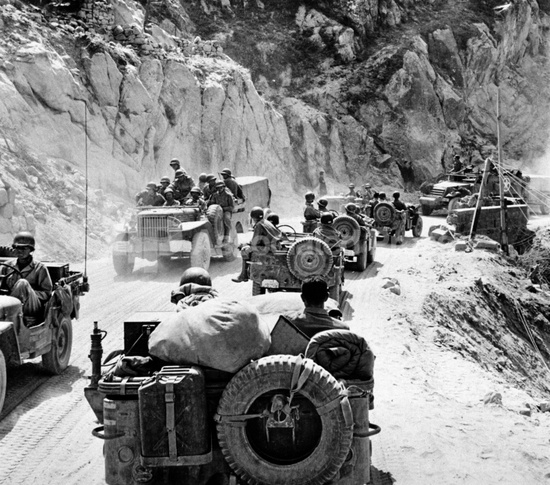
Meeting in Casablanca in January 1943, President Roosevelt, Prime Minister Churchill, and the Combined Chiefs of Staff decided that the large Italian island of Sicily would be their next target. Montgomery's British forces landed on the southeast coast, while Patton's newly activated Seventh Army landed on the southwest, with the mission of seizing airfields and protecting the flank of the British drive. Airborne troops spearheading the attacks scattered wide of their targets but managed to disrupt enemy communications. Hours after the initial landings on 9 July, German armor struck the American beaches. Naval gunfire, infantry counterattacks, and the direct fire of field artillery landing at the critical juncture broke up the German formations. But two attempts to reinforce the beaches with parachute and glider-borne troops ended in disaster when Allied antiaircraft batteries mistook the transport planes for enemy aircraft and opened fire, causing severe losses. Site: http://www.worldwariihistory.info/WWII/Italy.html |
Meanwhile, the Germans solidly blocked the British drive on the Sicilian capital, Messina. General Sir Harold R. L. G. Alexander, Allied ground commander, ordered Patton to push toward Palermo, at the western tip of the island. Once in Palermo, since the British drive was still stalled, his forces attacked Messina from the north. Patton used a series of small amphibious end runs to outflank German positions on the northern coastal road. American and British troops arrived in Messina on 17 August, just as the last Axis troops evacuated Sicily. |
|
Sicily |
Make a Free Website with Yola.
