The Bombing of Rome 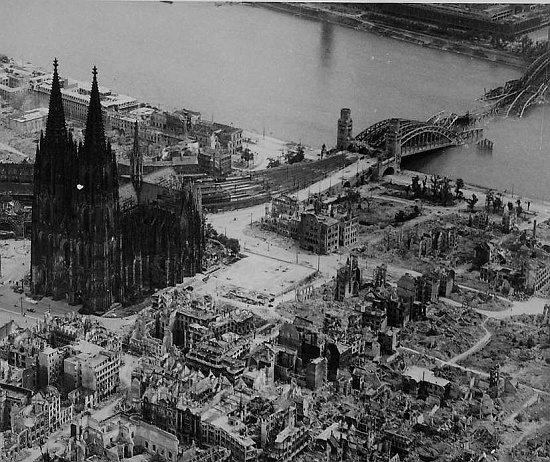 |
||
The bombing of Rome in World War II took place on several occasions in 1943 and 1944, by both Allied and Axis aircraft, before the city was freed from Axis occupation by the Allies on June 4, 1944. Pope Pius XII was initially unsuccessful in attempting to have Rome declared an open city, through negotiations with President Roosevelt via Francis Cardinal Spellman. Rome was eventually declared an open city on August 14, 1943—a day after the last Allied bombing—by the defending forces. In the 110,000 sorties, a deployment or dispatch of one military unit that comprised the Allied Rome air campaign, 600 aircraft were lost and 3,600 air crew members died; 60,000 tons of bombs were dropped in the 78 days prior to Rome's capture. |
Following the first Allied bombing of Rome on May 16, 1943 (three months before the German Army occupied the city), Pius XII wrote Roosevelt asking that Rome "be spared as far as possible further pain and devastation, and their many treasured shrines… from irreparable ruin." On June 16, 1943, Roosevelt replied: "Attacks against Italy are limited, to the extent humanly possible, to military objectives. We have not and will not make warfare on civilians or against nonmilitary objectives. In the event it should be found necessary for Allied planes to operate over Rome, our aviators are thoroughly informed as to the location of the Vatican and have been specifically instructed to prevent bombs from falling within Vatican City."Bombing of Rome was controversial, and General Henry H. Arnold described Vatican City as a "hot potato" because of the importance of Catholics in the U.S. Armed Forces. British public opinion, however, was more aligned towards the bombing of the city, due to the participation of Italian planes in The Blitz over London. |
|
Rome |
Make a Free Website with Yola.

